How Long Should Australian Businesses Keep Records Before Shredding Them?
For most Australian businesses, the safest starting point is this: don’t destroy records until the required retention period has ended.
Australians want private information destroyed without creating a trail of emissions or waste. That’s no longer a pipe dream. A mix of smarter equipment, cleaner fleets and tighter digital controls is reshaping paper shredding into a lower-impact, higher-assurance service that meets privacy duties and sustainability goals at the same time. For anyone weighing up a paper shredding service in Sydney, the shift is already visible in how providers design their sites, fleets and reporting.

Modern industrial shredders and balers use variable-speed drives, intelligent load sensing and low-power standby modes to cut electricity draw during quiet periods. Beyond the shred, high-efficiency horizontal balers compress fibre more tightly, which reduces transport runs and energy per tonne handled.
These gains matter because Australia is chasing net-zero across government operations and transport, and every avoided kilowatt-hour or litre of diesel helps. For routine document shredding in Sydney, asking a provider about kWh per tonne and bale density is a simple way to compare genuine efficiency rather than glossy claims.
The greenest bale is the one that travels the shortest distance. Shredding providers now use route optimisation and telematics to cut idling, reduce backtracking and time pick-ups to actual bin fill levels. Research on waste fleets shows that smarter routing can lower fuel burn and collection costs, with some trials reporting double-digit reductions in kilometres travelled.
Fleet technology is shifting too. Battery-electric refuse trucks are moving from pilot to practical, bringing quiet collections and zero tailpipe emissions on route. Businesses that sign up with a Sydney document shredding service can ask how often rounds are re-planned, whether dynamic routing is used on peak days and if low-emission vehicles are part of the mix.
Destroying paper securely remains a legal duty under the Privacy Act. The Office of the Australian Information Commissioner expects “reasonable steps” to prevent misuse and unauthorised access, including secure disposal when information is no longer needed. Shredding before recycling is recognised as a secure pathway for hard-copy records. To prove those steps, many providers align to i-SIGMA’s NAID AAA Certification.
Audits, chain-of-custody controls and employee screening are core features, and the program emphasises environmentally responsible disposition of shredded fibre. In practice, that means issuing digital Certificates of Destruction, recording custody events, and diverting output into pulping rather than landfill.
If compliance is front of mind, shortlist a document destruction Sydney provider that can share audit summaries and sample certificates on request.
Recycling only works if mills can use the feedstock. Shredding plants equipped with modern ferrous/non-ferrous removal, dust control and automated bale tying deliver cleaner, denser bales with fewer contaminants. That improves acceptance at domestic paper mills and reduces export dependence.
Australia’s latest waste reporting points to steady resource recovery and a shift in paper and cardboard flows, with exported volumes easing as domestic processing improves. Cleaner bales support that direction.
On the collection side, on-site services reduce handling steps that can introduce contaminants. Some providers pair that with real-time moisture checks to protect bale quality. If you prefer on-premise work, ask whether the operator offers mobile shredding in Sydney with documented bale specs and destinations.
Some shredders are formalising take-back relationships with printers, publishers and office supply chains to keep fibre cycling locally. Australia’s newsprint sector, for instance, reports near-total diversion of newspapers from landfill under long-running industry schemes, proving that high-volume, high-quality fibre can stay in circulation when the system is designed for it.
Those models inform how office paper can loop back into packaging and tissue grades after secure destruction. For agencies or clinics that can’t let files leave the premises, operators offering mobile document shredding in Sydney can process on site, issue a digital certificate and send bales straight to domestic pulping.
Also Read: What Happens to Your Documents After Shredding? A Simple Look at the Process
Eco-friendly document destruction is no longer a trade-off. Choose mobile shredding Sydney providers who can show, not just tell, and your shredded pages will live on as tomorrow’s packaging or tissue, with privacy protected and emissions trimmed.
For most Australian businesses, the safest starting point is this: don’t destroy records until the required retention period has ended.
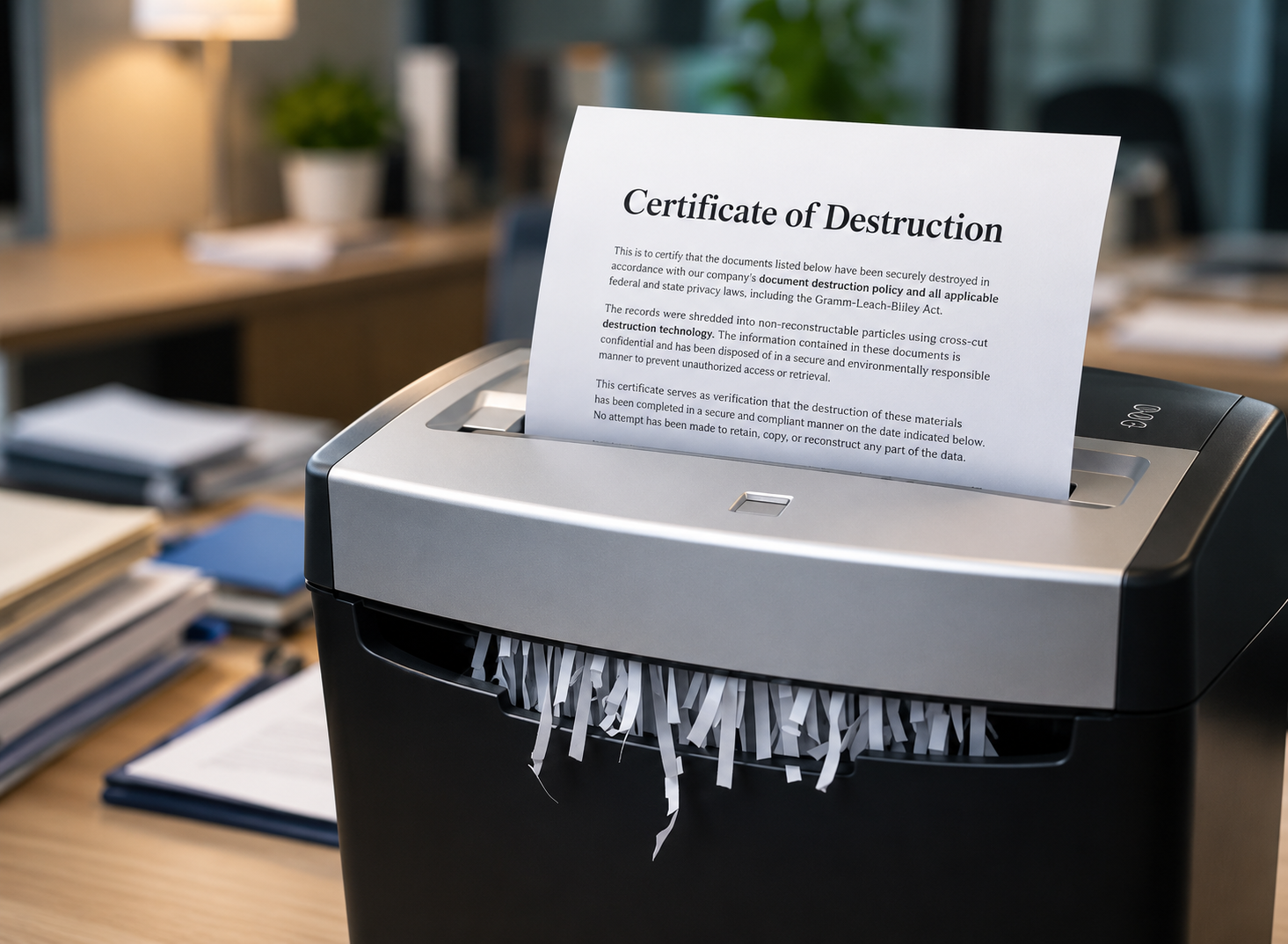
A Certificate of Destruction is one of the most important documents your business can hold after a shredding job. Yet many organisations misunderstand what it actually guarantees. Getting this wrong can leave you exposed during a compliance audit or a data breach inquiry under the Privacy Act 1988 (Cth). Here is a clear-eyed look at what the certificate confirms and, just as importantly, where its limits lie.
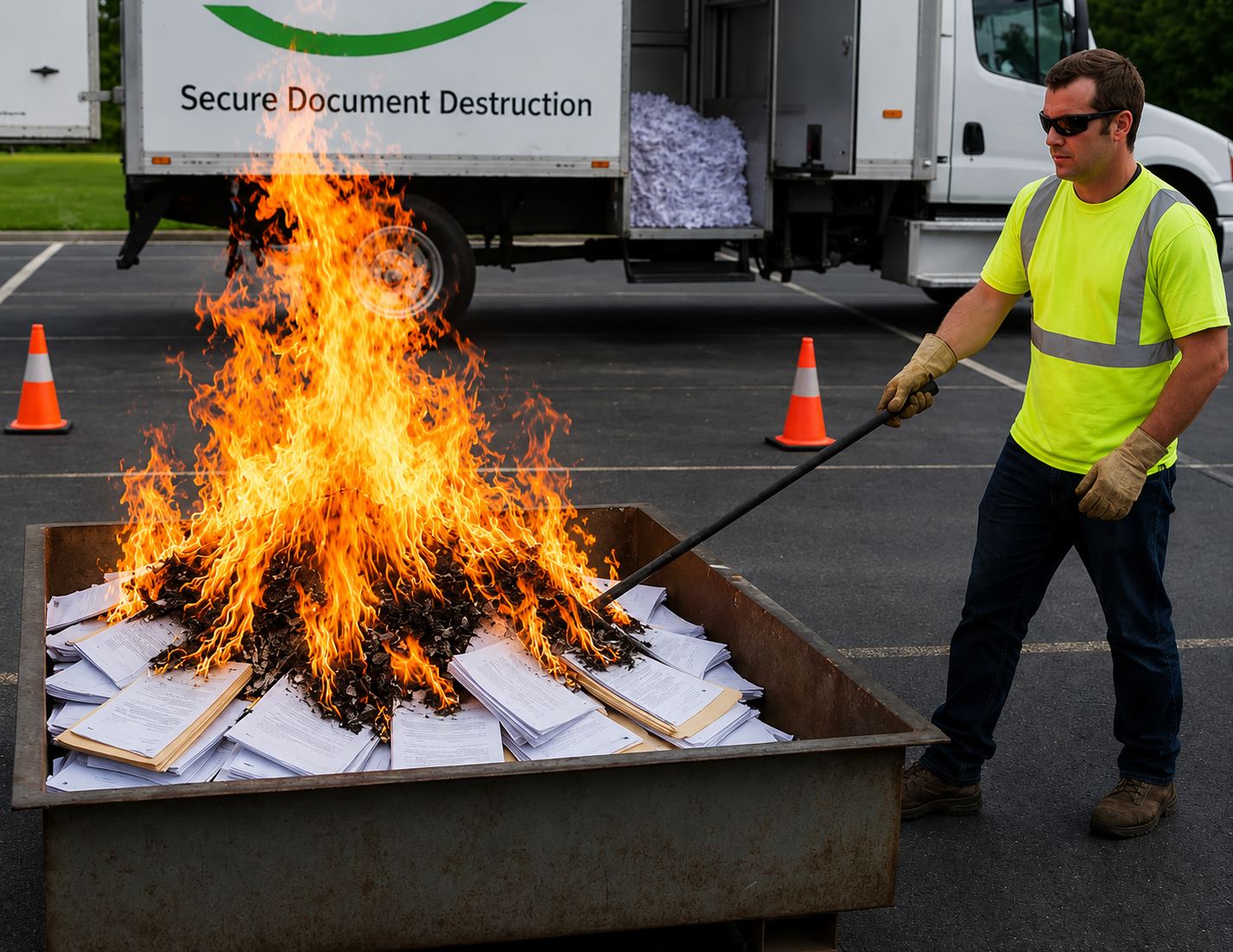
A quick burn can feel like the simplest way to clear out old paperwork. Yet for many households and small businesses, the safest approach is mobile document shredding services that destroy information on-site/off-site and leave far less to chance. Burning can create privacy gaps, safety hazards, and a mess of compliance headaches that only show up when it’s too late.
Book online in minutes. Pick your date and
we'll take care of the rest in a single visit.

© 2026 HelloShred | Privacy Policy | Website Designed & Developed by